The tax on first place
Why labs keep giving away models that cost billions, and what self-improving AI does to the bill.
AI labs have never made more money, and most tokens now run on free models. I've spent a month trying to work out which of those is eating the other.
On Vercel's gateway, open-weight models carry 71.5% of all tokens, while spend on frontier models is up tenfold since December. (One developer-heavy gateway, so read it as direction rather than size.) Both sides are winning at once, which is very annoying if you'd like the world to make sense. They can both be true for a while, since the leader only gets paid for the hard slice, and that's exactly what the next free model goes after.
A model is a melting asset
Put yourself in the leader's chair. I spend billions on a training run and get a model nobody can copy. Then it rots. A fixed level of capability gets about 13x cheaper every year, so whatever I charge today for "the smartest thing you can rent" rounds to zero in eighteen months. What I've actually bought is a lead, and leads are measured in months.
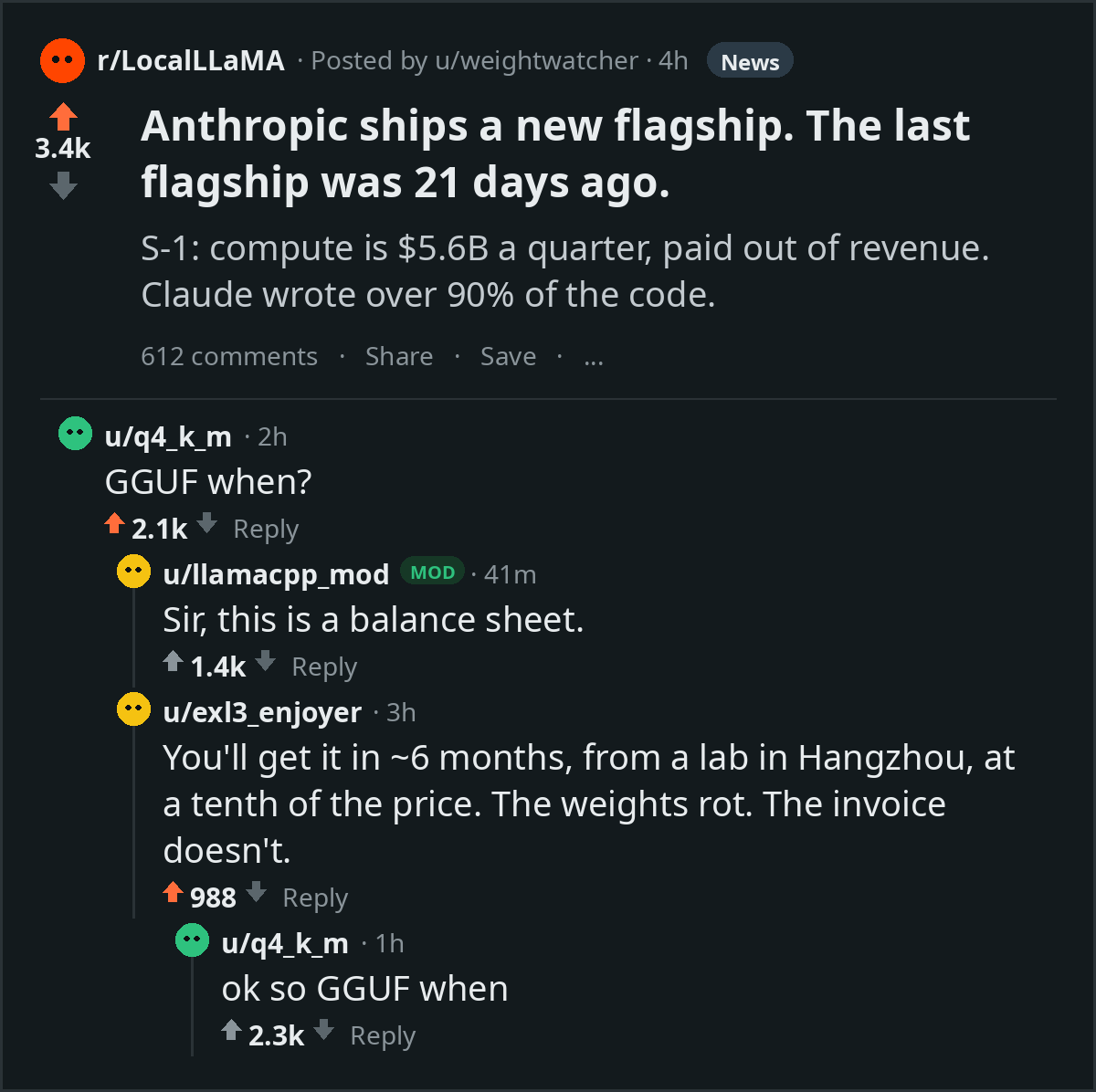
So the product is the war chest. Anthropic now spends $5.6 billion a quarter on compute, paid out of revenue and the money raised against it, and that revenue exists only because the model at the top beats the free one by enough that people pay a multiple for it. Margin → raised money → compute → next model → margin.
Giving it away is an attack
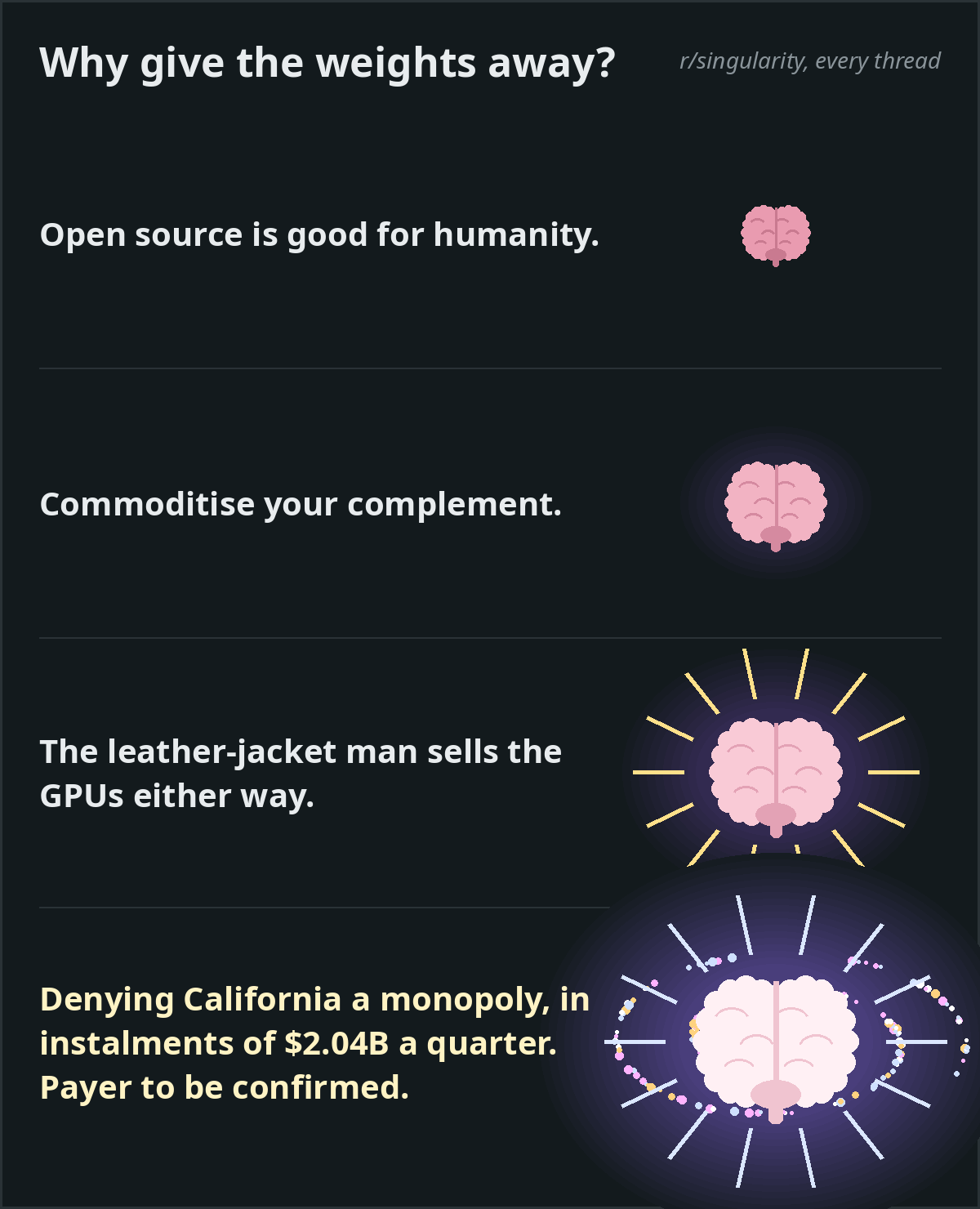
Now sit in the chair of a lab one notch behind. I can't charge the leader's price. But I can do the one thing the leader can't afford to, and give mine away. Every developer who settles for "almost as good, basically free" stops paying the premium that funds the leader's next run. A free near-frontier model is a recurring tax on the leader's next training run, levied by whoever is close enough to matter. Kimi K3.1 Pro scores 55 against Opus 5.5's 58, and Moonshot says the weights land by November 4 (I'll believe it when the repo exists).
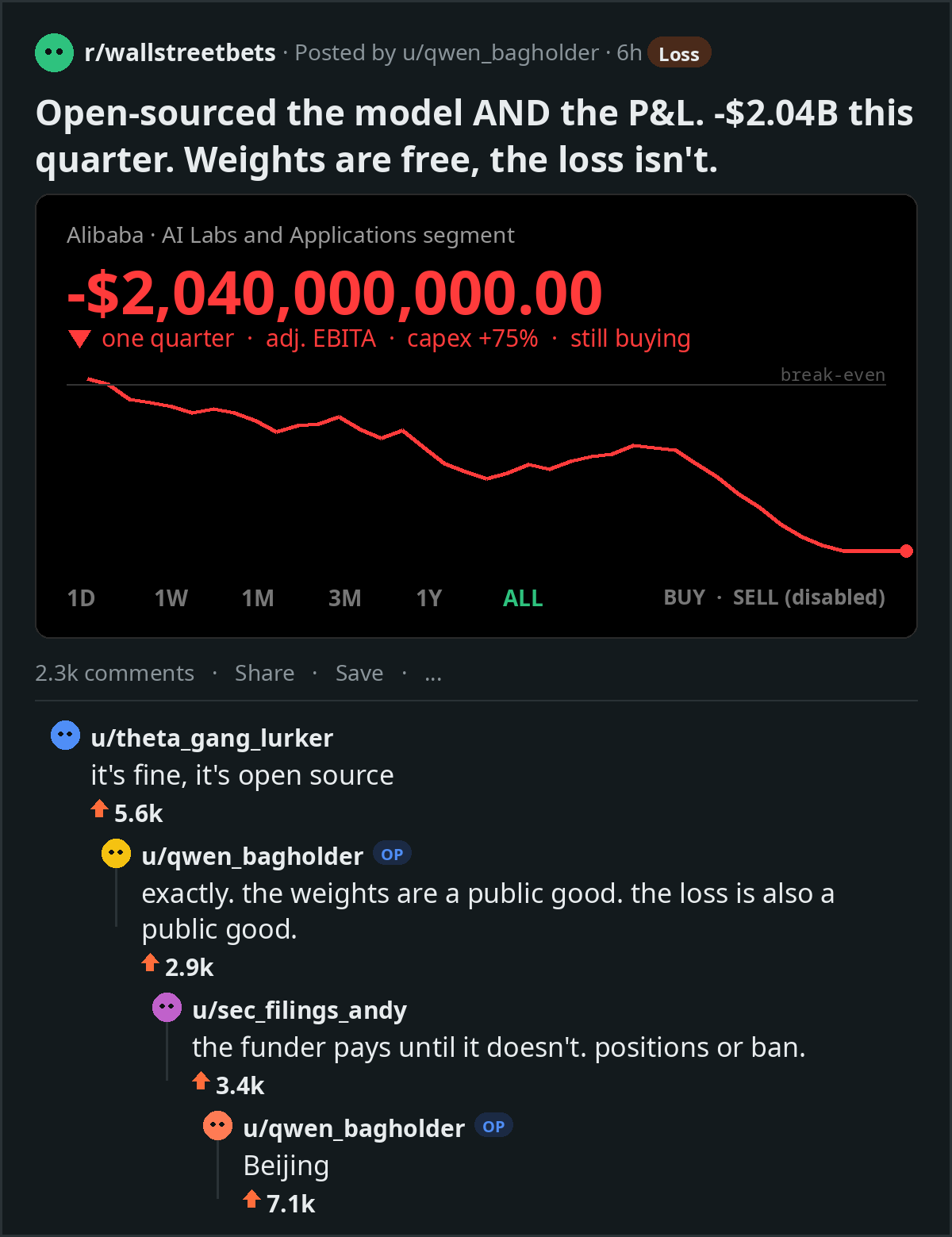
Isn't this just commoditize your complement? For Nvidia, yes: it sells what models eat. But Spolsky's complement was Linux, which once written stayed written, and anyone could fork it. A model expires in six months, and only the people who paid for it can rebuild it. Commoditizing a complement was a one-off purchase. This is a subscription. Alibaba's AI Labs and Applications segment lost $2.04 billion in adjusted EBITA in one quarter, on under half a billion of revenue (not a typo), and shipped the Qwen3.8-Max weights anyway. That's two billion a quarter so that Anthropic's margin doesn't compound.
The thing that could break this
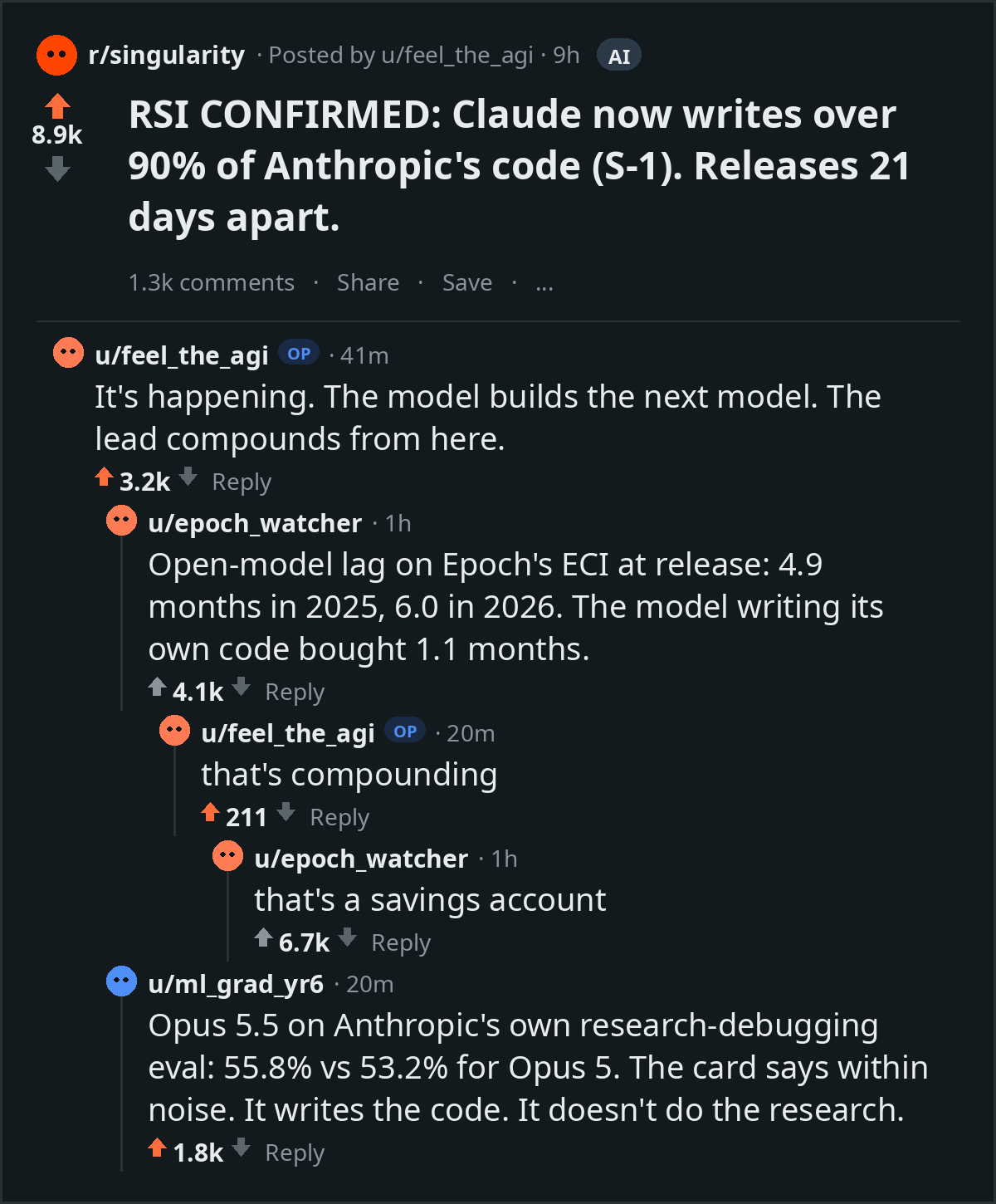
Here's where I'd expect to be wrong. If the leader can turn margin into compute, and compute into a model that builds the next model, the tax stops mattering: the loop gets a multiplier and nobody behind it gets one. Claude wrote over 90% of Anthropic's code in September (and probably most of the system card). Anthropic's last two records on Epoch's index landed 21 days apart. If an intelligence explosion looks like anything from the outside, it looks like a release calendar.
And yet Anthropic's own piece on this says recursive self-improvement is not inevitable, and that the limit may be chips and power rather than ideas. The Opus 5.5 system card tested it on Anthropic's own research debugging tasks: 55.8%, against 53.2% for Opus 5, which the card calls "not statistically distinguishable". The lab with the most to gain says it isn't there yet, and I kind of believe them, partly because it's the first time I've seen a lab understate its own model.
Nathan Lambert calls this lossy self-improvement, and his argument is about scaling laws. Each step up costs exponentially more compute, so a model that makes your engineers twice as fast doesn't double your lead. It buys you the same step a bit cheaper. And cheapness is the one thing that tends to leak: the trick gets written up, or the researcher leaves, or it gets distilled out of your API by the lab you're trying to outrun. Anthropic traced 151 million exchanges to Alibaba's lab in one summer.
Each new best open model shipped 4.9 months behind the frontier on average in 2025, and 6.0 in 2026, by my count from Epoch's data. That's widening, about a month a year (2024 was worse, at 8.5, so it's two years of data, not a law). If the lead were compounding you'd expect more than a month, and you'd expect it to speed up. A leak is what keeps the tax alive: a free model can only levy it from within one release of the top, and a month a year leaves it there.
It's a funding race
Self-improvement as it exists today speeds up engineering, which leaks, and runs on compute, which doesn't. So the tax bites harder: every dollar of margin the free model removes is compute the leader's loop never gets.
So where's the tax? Not in revenue. In share: between August and September, Anthropic's slice of Vercel's gateway dollars fell from 63.7% to 43.9%, with its revenue still climbing. Some of that went to OpenAI, which launched that month too, but that is what the tax looks like from the outside: share while everyone is growing, price the moment growth slows. One fact is eating the other, slowly and from the top.
The open side runs on someone else's budget. Alibaba's capex rose 75% in the quarter its lab lost two billion. A parent, a state or a Series D pays as long as the tax looks worth levying, and a state's reasons don't run out when the quarter does. No filing says Beijing pays for Qwen, so this is my read: a state is buying a guarantee that nobody in California owns the frontier, which is worth more to it than any margin.
Which leaves a fork. If AI learns to do research, and not just the engineering around it, the lead compounds and the tax is noise. If it doesn't, this is a capex war between one company's margin and one government's patience, and margins run out before governments do.
My call, on one metric: Epoch's ECI, the lag at release of each new open-weight record. If the 2027 average comes in under 7 months, the tax holds. Over 9, the lead is compounding and I'm wrong, and the world will have gone back to making sense, which I'll find even more annoying.